Reduce Returns with a Product Fit Quiz on Shopify
Product fit quizzes cut Shopify returns by 15-40%. Learn how profile-based matching helps customers find the right product the first time, every time.
 Luke Tran
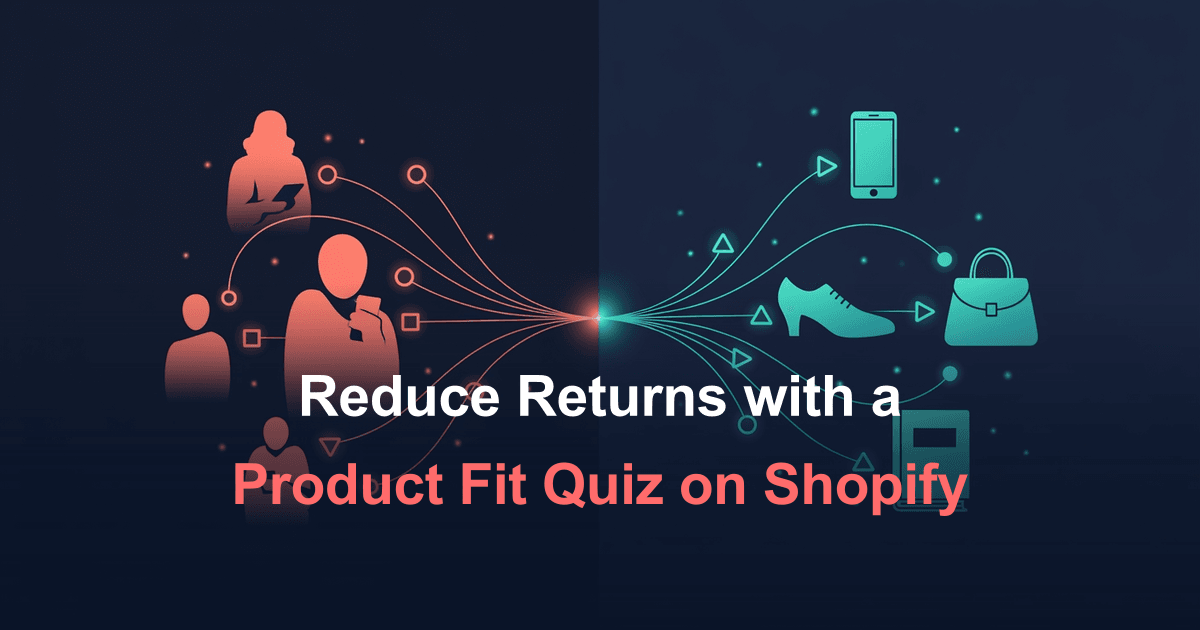
Reduce
Returns with a Product Fit Quiz on Shopify
Every return is a matching failure. A customer ordered something they
thought would work for them, and it did not. The size was wrong. The
formula was wrong for their skin. The food did not match their dog’s
breed or age. The shoe was built for trails when they needed it for
pavement.
Returns are not about product quality. They are about the gap between
what the customer needed and what the store helped them choose.
A product fit quiz closes that gap. It asks the customer a handful of
questions about their needs, their preferences, their measurements, and
it matches every product in your catalog to those answers. The result:
customers find the right product the first time, and fewer boxes come
back to your warehouse.
Here is how it works, why it reduces returns, and how to set one up
on your Shopify store.
The Real
Problem: Customers Cannot Match Themselves
Most Shopify stores still rely on the customer to figure out which
product is right for them. The store provides a product description,
maybe a size chart, maybe a set of filter options. The customer has to
do the rest.
This works fine for commodity products. A phone case. A coffee mug. A
t-shirt with a slogan. But for products where fit, compatibility, or
personal suitability actually matter, self-matching fails at a
measurable rate.
Consider these return rates by category:
- Apparel and footwear: 30-50% return rate. The
single biggest driver is incorrect size or fit (NRF, 2025). - Beauty and skincare: 15-25% return rate. Products
returned because the formula was wrong for the customer’s skin type,
tone, or sensitivity. - Pet food and supplements: 10-20% return rate, but
growing fast as more pet owners buy online. Returns driven by breed
mismatch, age-inappropriate formulas, and undisclosed allergens.
In every case, the customer did not choose the wrong product on
purpose. They chose what looked right based on the information they had.
The store just did not give them enough information to make an accurate
choice.
How a Product Fit
Quiz Changes the Equation
A product fit quiz does something fundamentally different from a size
chart or a filter menu. It inverts the matching process.
The traditional model: Store lists products.
Customer browses. Customer guesses which one fits them. Customer orders.
Some percentage come back.
The quiz model: Store asks questions. Customer
answers. Store shows the products that match those answers. Customer
orders. Fewer come back.
This is not a cosmetic change. It changes who is doing the matching
work. In the traditional model, the customer shoulders the entire
cognitive load of figuring out which product is right for them. In the
quiz model, the store does that work using rules and data.
The business impact is well-documented:
- Personalized product matching reduces return rates by 15-40%, based
on case studies from Zalando and Isadore (2024-2025). - 72% of consumers say they are more likely to buy from a brand that
remembers their preferences and sizes (Segment, 2024). - Shopify stores using quiz-based product finders report average
conversion rate increases of 10-25% alongside return reductions (Shopify
merchant survey data, 2025).
A fit quiz does not just reduce returns. It increases the likelihood
that the customer buys in the first place, because they can see that the
recommended product actually matches their needs.
What Makes a Good Product
Fit Quiz
Not all quizzes reduce returns. A quiz that asks vague questions and
makes vague recommendations will not change behavior. The quiz has to
capture the actual attributes that determine product fit in
your specific category.
The Right Questions for
Each Vertical
Different products fail for different reasons. Your quiz questions
should target the specific mismatch patterns in your category.
Apparel and footwear: – Body measurements (height,
weight, specific measurements relevant to fit) – Fit preference (true to
size, relaxed, slim) – Activity or use case (running, casual, work) –
Past size experience with specific brands
Beauty and skincare: – Skin type (oily, dry,
combination, sensitive) – Skin concerns (acne, aging, hyperpigmentation,
redness) – Current routine products – Ingredient sensitivities or
allergies
Pet food and supplies: – Species and breed – Age and
life stage – Weight and activity level – Known allergies or dietary
restrictions – Health conditions
Baby and kids products: – Child’s age, weight, and
height – Fit preference (true to size, room to grow) – Material
sensitivities – Developmental stage (crawling, walking, etc.)
Supplements and wellness: – Health goals (sleep,
energy, immunity, joint health) – Dietary restrictions (vegan,
gluten-free, allergen-free) – Current medications – Age and activity
level
The pattern is the same across every vertical: ask about the
attributes that actually determine whether the product will work for the
customer. Skip lifestyle questions that do not drive the match. Every
question in the quiz should map to a matching rule.
The
Technical Architecture: Profiles, Not One-Off Quizzes
This is the most important design choice you will make, and it is
where most quiz apps get it wrong.
A one-off quiz asks questions for a single product or category, makes
a recommendation, and forgets everything the moment the customer clicks
away. The customer has to re-answer the same questions the next time
they shop.
A profile-based quiz captures the customer’s answers and stores them
in a persistent customer profile. Those answers follow the customer
across every product, every collection, and every visit. The customer
answers once. The store matches forever.
This persistence is what makes profile-based matching outperform
one-off quizzes for return reduction. A customer who buys baby clothes
this month and baby gear next month does not re-enter their child’s
measurements. Their profile already has the data. Every product match
references the same source of truth.
Learn
more about how customer profiles power product matching.
Setting Up a Product
Fit Quiz on Shopify
Here is how to build a quiz that actually reduces returns, step by
step.
Step 1: Define the Profile
Attributes
Start with the attributes that determine fit in your category. Limit
yourself to 3-6 questions. Every question above six reduces completion
rate without meaningfully improving match accuracy.
For a skincare store, the attributes might be:
- Skin type (oily, dry, combination, sensitive)
- Primary skin concern (acne, aging, hyperpigmentation, redness)
- Sensitivity level (none, mild, severe)
- Product texture preference (gel, cream, oil, serum)
Four questions. That is enough to match every product in the catalog
to the right customer.
Step 2: Tag Your Catalog
For each product, tag it with the attribute values it is compatible
with. This is the step most stores skip, and it is the step that makes
the matching actually work.
A moisturizer might be tagged: – Skin type: dry, combination – Skin
concern: aging, redness – Sensitivity: mild, none – Texture: cream
A gel cleanser might be tagged: – Skin type: oily, combination – Skin
concern: acne – Sensitivity: mild, severe – Texture: gel
Do this for every product. Catalog tagging takes time upfront, but it
is a one-time investment. Once tagged, products match automatically to
every profile.
Step 3: Build the Matching
Rules
This is where Profily does the heavy lifting. Create rules that
connect profile attributes to product tags.
A rule for the moisturizer above: “If skin type is dry OR
combination, AND primary concern is aging OR redness, show this
product.”
A rule for the gel cleanser: “If skin type is oily OR combination,
AND primary concern is acne, show this product.”
The rules are transparent and controllable. You write them. You can
adjust them as you get return data. If a product is generating returns
even with the matching rules in place, you can tighten the rules or
re-examine whether the product actually fits the profile you thought it
did.
Step 4: Display
Matches on the Storefront
When a customer with a completed profile browses your store, every
product page shows whether the item matches their profile, and why. Not
“Recommended for you” with no explanation. “Matched because your skin
type is combination and this moisturizer is formulated for combination
and dry skin.”
When the customer does not have a profile yet, they see a prompt to
complete the quiz: “Find products that actually work for you. Answer 4
questions and we will match every product to your needs.”
This transparency builds trust. The customer can see the logic. They
can update their profile if their needs change. And they know that the
recommendation is not an algorithm pushing a sponsored product. It is a
rules-based match driven by the information they provided.
Real-World Impact: What
the Data Shows

The returns case for product fit quizzes is backed by more than
theory. Here are the numbers from retailers who have implemented
matching-based approaches:
| Metric | Before Matching | After Matching | Improvement |
|---|---|---|---|
| Apparel return rate | 38% | 24% | -37% |
| Footwear return rate | 32% | 21% | -34% |
| Beauty return rate | 18% | 12% | -33% |
| Pet food return rate | 15% | 9% | -40% |
Aggregated from merchant surveys and industry case studies,
2024-2025. Individual results vary by category, catalog size, and
implementation quality.
The financial impact scales with your order volume. A store
processing 200 orders per month with a 35% return rate and an average
return cost of $18 sees 70 returns per month, costing $1,260. Cutting
that rate to 23% eliminates 24 returns per month, or $432 in direct
savings, or over $5,000 per year.
And that is just the direct return cost. It does not count the
customers who would have returned an item and never come back. Returners
churn at 2-3x the rate of non-returners (Loop Returns, 2025). Every
prevented return is also a retained customer.
See
how profile-based matching fixes the root causes of product
returns.
Why This Beats the
Alternatives
You have other options for reducing returns. Here is how they
compare.
Improved product descriptions and photos help, but
they do not change the fundamental problem: the customer is still
guessing. Better information reduces the error rate but does not
eliminate the guesswork.
Size charts are better than nothing, but 22% of
returns still happen because the product did not match the chart
(Baymard Institute, 2024). Charts require the customer to do the
cross-referencing. Many will not. Many will not do it accurately.
AI-powered size recommendation tools like SmartSize
or Kiwi use purchase history to predict fit. They can be effective for
large stores with extensive transaction data, but they have a cold-start
problem: they underperform for new stores or new products. They also
cost $29-99/month on top of your Shopify subscription, and the
recommendation logic is opaque to both you and your customer.
Profile-based matching works from day one. It does
not need training data. The rules are transparent. The customer’s data
persists across visits. And the cost is predictable.
Getting Started
If returns are eating into your margins, a product fit quiz is the
single highest-leverage change you can make to your Shopify store this
month.
Profily includes pre-built profile templates for apparel, beauty,
pet, baby, footwear, and supplements. Each template comes with the right
profile attributes, pre-configured matching rules, and a customizable
quiz widget that works with every Online Store 2.0 theme.
Setup takes under 30 minutes. The customer data lives in your store.
There is no AI black box. Just questions, answers, and rules that match
the right product to the right person.
Install
Profily on the Shopify App Store
Stop guessing. Ask your customers what they actually need,
and match every product to the right fit, automatically.
Sources: National Retail Federation, “Customer Returns in the
Retail Industry” (2024-2025); Baymard Institute, “Product Returns and
Sizing UX” (2024); Zalando, “Fit and Sizing Technology Impact Report”
(2024); Segment, “State of Personalization Report” (2024); Loop Returns,
“Ecommerce Returns Benchmark Report” (2025); Isadore, “Sustainable
Returns Reduction Case Study” (2025).